 Book now
 Who were the Tugendhats, and what happened to their villa?
The family behind Mies van der Rohe's Brno house, the eight years they lived there, and everything that followed up to UNESCO.
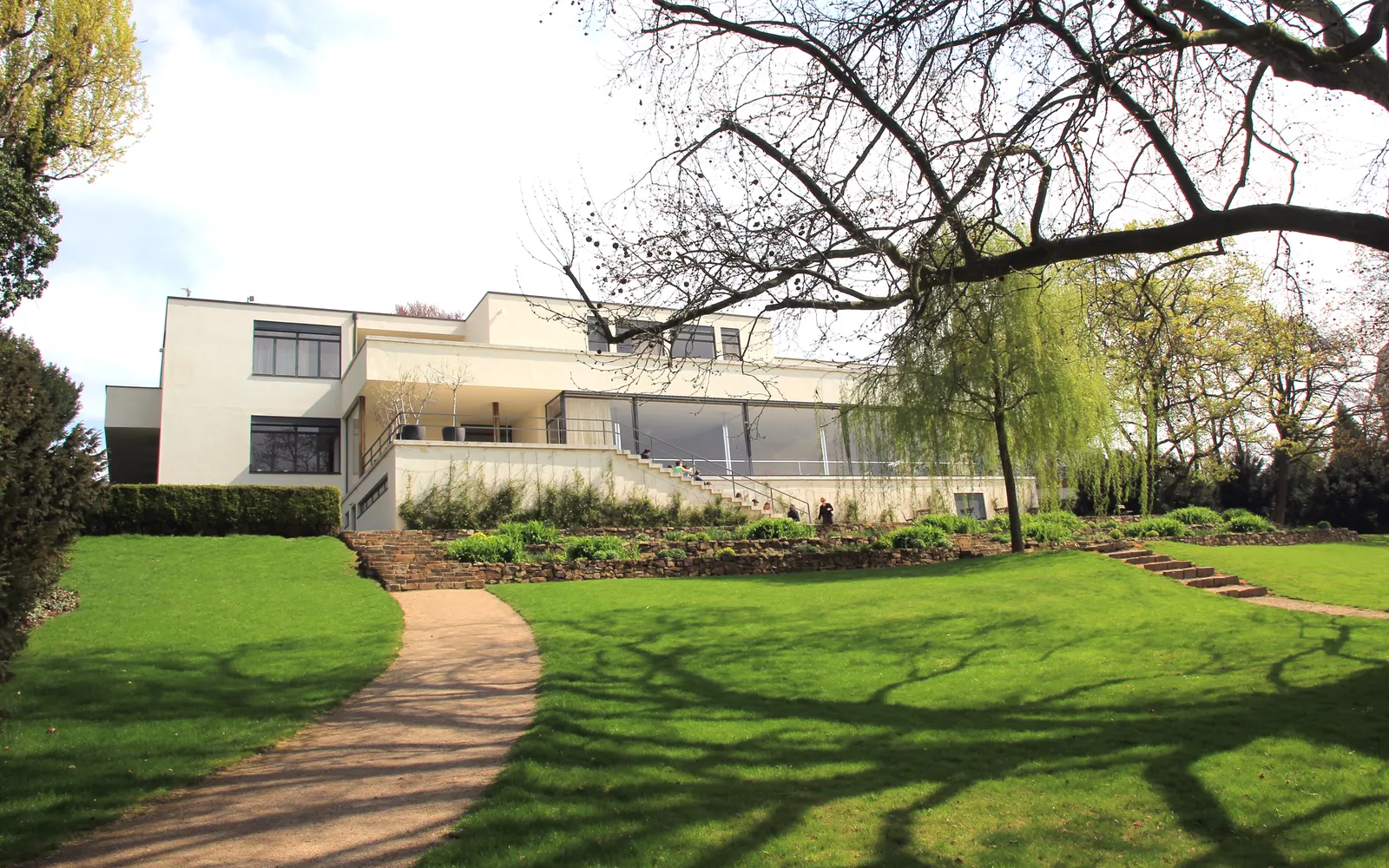
Grete and Fritz Tugendhat lived in their villa for less than eight years, from December 1930 to May 1938. After they fled the Nazi threat, the house passed through the Gestapo, a Soviet cavalry unit, a dance school, a children's clinic and the City of Brno before it opened as a museum in 1994. Grete's father, Alfred Löw-Beer, gave her the plot in March 1929. Ludwig Mies van der Rohe and Lilly Reich designed the house, and the Brno firm of Artur and Mořic Eisler built it in fourteen months. This guide follows the family and the building year by year, drawing on the villa museum's own published history. It ends where that story is told today: the exhibition on the family on the technical floor.
Who were Grete and Fritz Tugendhat?
Grete Löw-Beer was born in 1903 and Fritz Tugendhat in 1895. Both came from Jewish German families of industrialists and traders who had lived in Brno for several generations. The Löw-Beers had been settled in Moravia since the 17th century. Their wool factories in Brno and nearby Svitávka were among the most important in the region.
Grete broke off her economics studies in Vienna and married the industrialist Hans Weiss in 1922. She spent most of that unhappy marriage in Germany, and it ended after six years. In Germany she came to know modern art and architecture. She often visited a house Mies van der Rohe had built for the art dealer Perls, and the Weissenhof housing estate in Stuttgart left a deep impression on her.
Fritz had first wanted to study medicine. He cared more about the technical side of textile making and the design of good cloth than about selling it. The couple co-owned two Brno wool firms, Feldhendler et Co. and Max Kohn, and traded mainly in cloth. Grete and Fritz had known each other almost since childhood. They married soon after her divorce, and the museum's timeline places the wedding in 1928.
How did Mies van der Rohe come to build a house in Brno?
Grete was the driving force behind the commission, with Fritz's full support. In her own words: “I truly longed for a modern spacious house with clear and simple shapes.” Fritz, for his part, dreaded the rooms crowded with objects and fabrics he had grown up in. The introduction to Mies probably came through the art historian Eduard Fuchs, who lived in the Perls house, or through Lilly Reich, who often visited Fuchs there.
Mies came to Brno in September 1928. The plot, high on the slope of the Černá Pole villa district with a wide view over the old city, persuaded him to accept. It was the upper part of the garden of the Löw-Beer villa, which Alfred Löw-Beer had bought in 1913. Alfred gave the land to Grete in March 1929 and paid for the building. Grete applied for a building permit in April 1929, and it was granted that October.
Mies was impressed by the standard of building in Brno and gave the work to a local contractor, the firm of Artur and Mořic Eisler. They started in summer 1929 and finished in fourteen months. Mies chose a steel skeleton for the house, partly because of the steep slope. On the first plan the Tugendhats saw small crosses drawn about five metres apart. Mies explained calmly that these were the iron supports carrying the whole structure. Grete recalled that no private house had been built that way before.
What was family life like in the villa?
The family moved into the finished house in December 1930. They lived there with three children: Hana, Grete's daughter from her first marriage, and the sons Ernst and Herbert. A governess from Berlin, Irene Kalkofen, joined the household in February 1931. Grete later summed up their feeling in one line: “From the first moment we truly loved the house.”
Grete described two ways of using the great main room. On their own, the couple sat in the library behind the onyx wall. With friends, they spent evenings in front of the milk-glass wall, lit from behind with a soft light. In spring and summer the children lived on the terrace. They had a tub for splashing and a sandpit in the shade, and they rode skates and toy cars from one end to the other. In winter they could sledge down the meadow garden to their grandparents' house next door.
The Tugendhats did not lead a busy social life, but once a year they held a bridge tournament in the villa for up to 100 invited guests. The proceeds went to the League for Human Rights. From 1933, after Hitler took power in Germany, Grete worked for the League, which gave money and practical help to political refugees from Germany.
In 1931 the magazine Die Form ran an article on the house by its publisher, Walter Riezler. The art historian Justus Bier replied with a pointed question: can one live in the Villa Tugendhat? The Tugendhats answered in print, alongside a text by the architect Ludwig Hilberseimer. They rejected the idea that such a grand space only allowed ceremonial, showpiece living, and said they were fully satisfied with how flexible it was. Fritz, a keen amateur photographer, left the proof: family pictures of calm, ordinary home life.
Why did the Tugendhats leave Brno in 1938?
Through their contacts in Germany, the Tugendhats knew what was coming. The museum's history says that staying in Brno would have meant certain death for the whole family. In May 1938 Grete and the children left for St Gallen in Switzerland.
Fritz stayed behind for a short time with the governess, Irene Kalkofen, to pack personal belongings and some furniture for shipping. Kalkofen left for England at the beginning of July 1938, and she came back to see the villa in 1995. The family's chauffeur, Gustav Lössl, stayed on in the house until early September 1941.
In January 1941 the family moved on again, this time to Venezuela. Two more daughters, Ruth and Daniela, were born in Caracas. After the war the Tugendhats returned to Switzerland, but they never lived in the villa again. Fritz died in 1958.
What happened to the villa during the war?
The Gestapo took over the house at the beginning of October 1939, and from January 1942 it was the property of Nazi Germany. A German soldier who stayed there in autumn 1940 reported that the curved Macassar ebony wall and most of the furniture had already gone. Parts of the original wood panelling turned up decades later at Masaryk University, in a building the Gestapo had used as its Brno headquarters.
In the 1940s Walter Messerschmidt, director of the Klöckner works in Brno, used the villa as his flat and office and changed it heavily. He had the milk-glass wall on the street façade bricked up, along with the entrance from the upper terrace. He raised the chimney and added new partition walls inside.
In April 1945, as the Soviet Army took Brno, a cavalry regiment under Marshal Malinovsky did severe damage. A neighbour, Vlasta Hvozdecká, remembered riders tearing down about six metres of garden fence. She recalled that they turned the grand living rooms into a stable for their horses. What furniture remained was burned as firewood, hooves ruined the linoleum, and blast waves from the bombing broke the glass walls.
A written report made at the end of the war records smashed panes, glass and manure across the main living area. Only the onyx wall and the built-in bookcase had survived there. The motors for the air system and for lowering the windows were missing, and the boiler was damaged. The windows were then glazed provisionally.
Who used the villa between 1945 and 1980?
From August 1945 to June 1950 the house held the private dance and physical-education school of Karla Hladká, who taught at the Brno conservatory. In October 1950 the Czechoslovak state took ownership. The villa then became a rehabilitation centre for children with spinal problems, part of the nearby children's hospital, until the end of the 1960s.
Efforts to save the house began in the early 1960s, led by the Brno architect František Kalivoda. The first step came in December 1963, when Villa Tugendhat was listed as a cultural monument. Kalivoda invited Grete, then living in St Gallen, to Brno. She came in November 1967, her first visit in 29 years. Afterwards she wrote that the clinic was clean and well kept, but the alterations were so bad that no one could picture the original house.
On 17 January 1969 Grete gave a talk in Czech at the Brno House of Arts, during an exhibition on Mies's work. She described how the house was built and how the couple worked with the architect. One story she told: when Fritz objected to doors running from floor to ceiling, Mies replied that in that case he would not build. Her talk remains a unique source for historians of the house.
Hopes for a full restoration faded after the 1968 occupation of Czechoslovakia. Mies died in August 1969, Grete in December 1970 and Kalivoda in May 1971. In 1980 the villa passed from the state to the City of Brno.
How did the villa become a museum and a World Heritage Site?
The first full renovation ran from 1981 to 1985. The city wanted it for promoting Brno and housing occasional guests, not for the public. The great panes were replaced by two sheets of glass joined in the middle, the original linoleum gave way to locally made PVC, and the last surviving original window opposite the onyx wall was removed because it did not match the new glazing.
On 26 August 1992 the house played a part in a larger history. Václav Klaus and Vladimír Mečiar met there to sign the document that divided Czechoslovakia into the Czech Republic and Slovakia. In 1994 the villa opened to the public as a museum run by the city. In 2001 it was inscribed on the UNESCO World Heritage List, and it is still the only example of modern architecture in the Czech Republic on that list.
Research from 2003 to 2005 was supervised by Professor Ivo Hammer, husband of Daniela Hammer-Tugendhat. The second restoration ran from February 2010 to February 2012, and the villa reopened in March 2012. The house and garden were returned to their appearance on completion in 1930, and the rooms were furnished with exact replicas of the original pieces.
Where can you see the family's story when you visit?
The museum now tells this story inside the house. When the technical equipment was restored in the basement, the same floor became home to an exhibition on the architect, the owners and the family's life in the villa up to 1938. The Basic tour (60 minutes) covers the bedroom floor with the upper terrace, the main living floor with the onyx wall and dining area, the garden if the weather allows, and this exhibition.
The Extended tour (90 minutes) adds the technical floor itself, which holds the most personal rooms in the house: Fritz Tugendhat's photo darkroom, the fur-coat safe or “moth room”, the laundry, the boiler room, the air-conditioning machinery and the machine room that lowers the two big windows into the floor. Groups are at most 16 people. The public English tours are Extended tours, normally at 12:00 and 15:00, Tuesday to Sunday. Basic tours are led in Czech, with a printed English text or a phone audio guide in 12 languages.
Places are scarce. New dates go on sale in weekly batches on Sunday evenings at 18:00 Brno time, roughly 12 to 13 weeks ahead, and the museum warns that tours can sell out in a few moments on the opening day. On 14 October 2026 every Basic and Extended tour was full. You can book with us for any date, including dates not yet released. We place your booking the moment your date opens and email you the e-ticket once it is issued. If your chosen tour has gone, we tell you and offer the tours still open that day.
Frequently asked
How long did the Tugendhat family live in the villa?
Less than eight years. Grete and Fritz moved in with their children in December 1930. Grete and the children left for St Gallen in Switzerland in May 1938, while Fritz stayed briefly to pack. The family moved on to Venezuela in January 1941 and never lived in the house again.
Did Grete Tugendhat ever return to the villa?
Yes. She came back in November 1967, her first visit in 29 years, and found the house badly altered. On 17 January 1969 she gave a talk in Czech in Brno about how it was built. She visited several more times before her death in December 1970.
Is the furniture in Villa Tugendhat original?
Mostly not. The furnishings disappeared during the war, and in 1945 only the onyx wall and the built-in bookcase survived in the living room. The 2010–2012 restoration furnished the rooms with exact replicas of the original pieces.
What happened at Villa Tugendhat in 1992?
On 26 August 1992 Václav Klaus and Vladimír Mečiar signed the document dividing Czechoslovakia into the Czech Republic and Slovakia at the villa. Two years later, in 1994, the house opened to the public as a museum.
When did Villa Tugendhat become a UNESCO World Heritage Site?
In 2001. It is the only example of modern architecture in the Czech Republic on the UNESCO list.
Which tour shows the family's history?
Both tours include the exhibition on the family on the technical floor. The 90-minute Extended tour also takes you into the technical rooms, including Fritz Tugendhat's photo darkroom and the fur-coat safe. Public English tours are Extended tours, normally at 12:00 and 15:00, Tuesday to Sunday.